

Cancer Prevention, Screening, and the Reality of Cancer
July 13, 2024
Best nutrition during cancer treatment
July 13, 2024
Dr. N.A. SIDDIQUI
MBBS, MD (Medicine),DM (Medical Oncology),FRCP(Medical Oncology),PDCR
ESMO Certified Medical Oncologist
PAncreatic cancer IS difficult to treat in large part because it often isn’t discovered until the disease has spread to other parts of the body. That’s because in many cases there are no signs or symptoms until cancer has reached an advanced stage. Even when there are early signs and symptoms, they are often vague, so patients tend to ignore them or doctors attribute them to another disease. For these reasons, pancreatic cancer is often known as a silent killer.
“There is not a single (symptom) that lets you home in specifically on pancreatic cancer,” says Dr.Brian Wolpin, Director of the Lustgarten Foundation Pancreatic Cancer Research Laboratory at Dana-Farber Cancer Institute and an associate professor of medicine at Harvard Medical School. “They tend to occur later in the disease course, so for most people, a small tumor will not be symptomatic. Symptoms develop later when the tumor is larger or has spread.”
Even when symptoms do develop, “they are not a very good way to find the disease,” because they may be confusing to patients and doctors. The symptoms also vary depending on where the tumor is located in the pancreas, which consists of a head, body, and tail.
The signs and symptoms of pancreatic cancer that need to be taken seriously include:
- Jaundice (with or without itching), dark urine, or light-colored stool.
- General symptoms such as back pain, fatigue, or weakness.
- Other illnesses, including pancreatitis and new-onset diabetes in an adult.
- Digestive problems, such as unexplained weight loss, loss of appetite, malnutrition, nausea or vomiting, and abdominal pain.
- Blood clots, which may cause pain, swelling, redness, and warmth in the leg, chest pain, or trouble breathing.
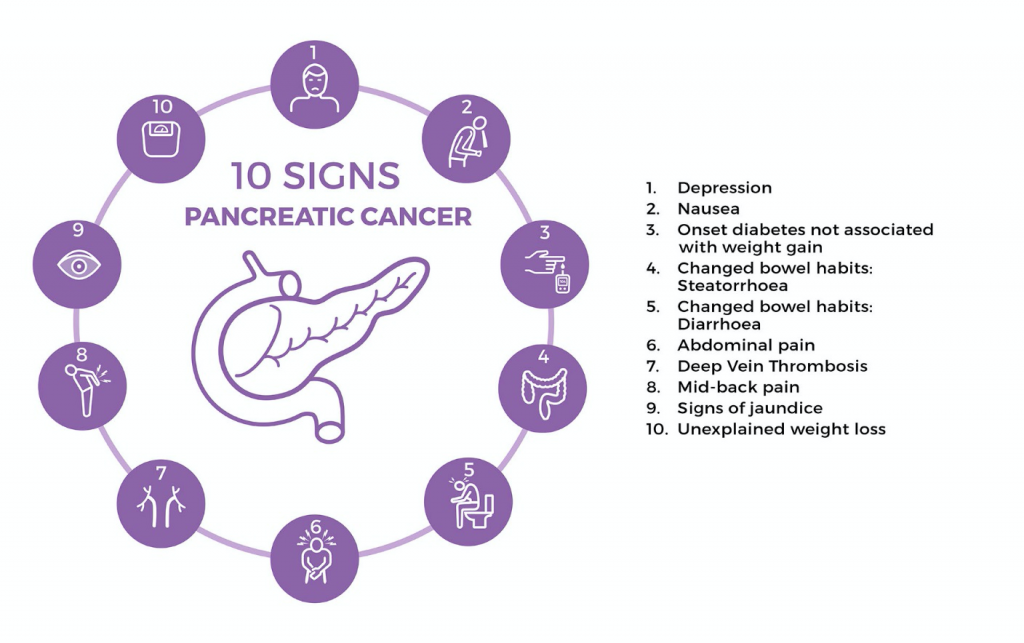
Pancreatic Cancer Symptoms to Take Seriously
Jaundice causes a yellowing of the skin and the whites of the eyes. Jaundice may also cause signs and symptoms such as itching (which may be severe), dark urine and light or clay-colored stool. Pancreatic cancer can lead to jaundice when a tumor blocks the bile duct. Bile, produced in the liver to aid digestion, contains a dark yellow substance called bilirubin. If the bile is blocked, it accumulates in the blood, skin and other tissues, causing jaundice.
“The main symptom is abdominal discomfort. That sometimes radiates into the back because the pancreas is in the back of the abdomen. The pain may be constant or occasional and can worsen after eating or when lying down. Of course, many conditions other than pancreatic cancer can also cause abdominal or back pain, which makes this a challenging symptom to attribute to pancreatic cancer.
Pancreatic cancer may cause digestive problems and weight loss. When pancreatic enzymes cannot be released into the intestine, digesting food, especially high-fat foods, may be difficult. Over time, significant weight loss and malnutrition may result. If the tumor blocks the upper part of the small intestine, that can lead to nausea and vomiting.
What Cause Cancer –
Pancreatitis, which is an inflammation of the pancreas, can be a sign of pancreatic cancer if the condition is chronic or when it appears for the first time and is not related to either drinking alcohol or gallstones.
Developing diabetes mellitus (high blood sugar), especially after the age of 50, can be a sign of pancreatic cancer,”Cancer seems to cause diabetes in some cases, so a new onset of diabetes, particularly later in life and with weight loss, is a sign.
Pancreatic cancer can cause blood to clot more easily. The clots can block blood flow in the legs, lungs or other organs such as the pancreas itself or liver.
While many other illnesses can cause these signs and symptoms, it is important to take them seriously and see your doctor as soon as possible.