
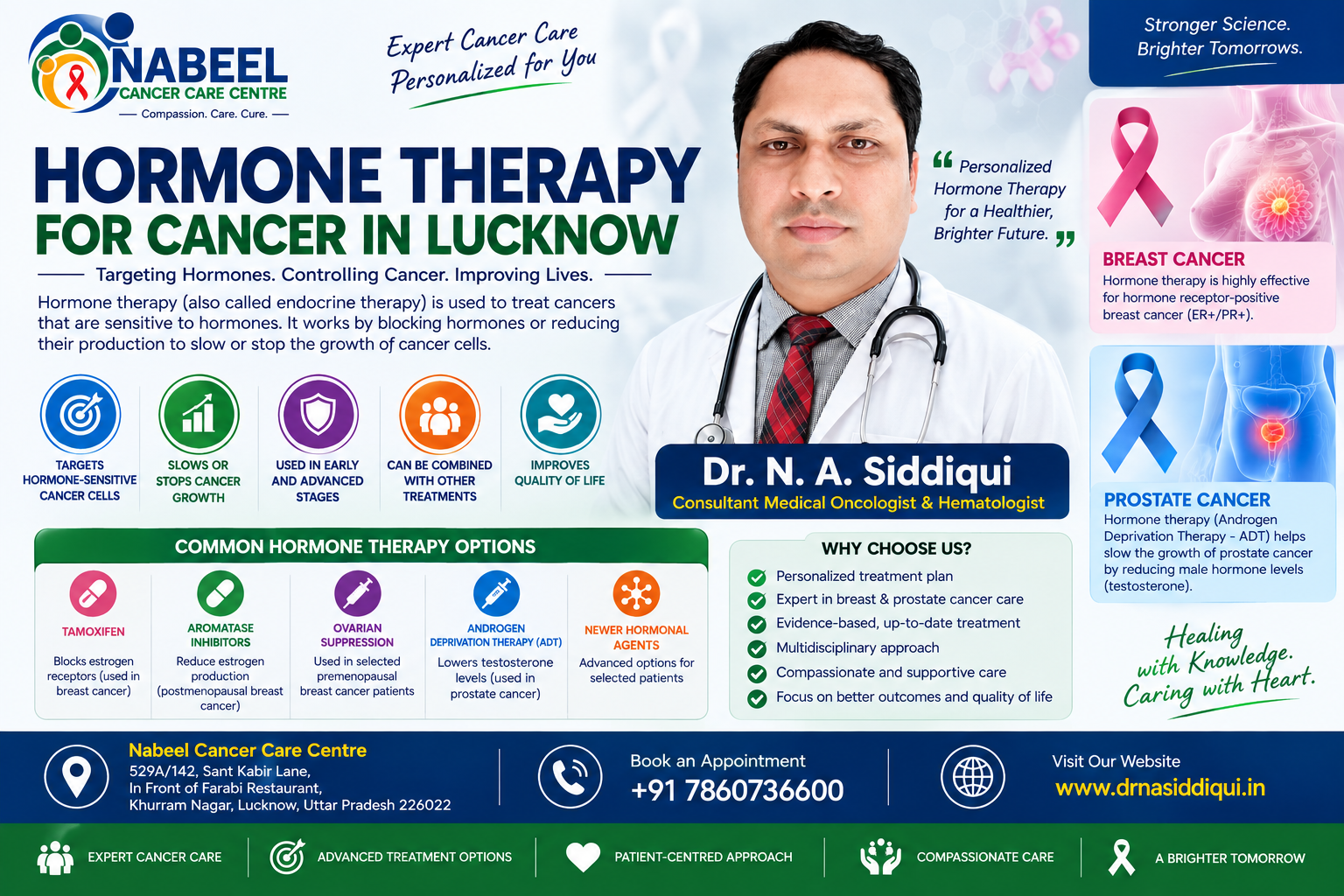
Hormone Therapy for Cancer in Lucknow – Dr. N. A. Siddiqui
Cancer treatment is becoming increasingly personalized. Not every patient needs chemotherapy, and not every type of cancer responds to the same medicines.
Some cancers depend on naturally occurring hormones in the body to grow. When this happens, hormone therapy may become an important part of cancer treatment.
If you are looking for Hormone Therapy for Cancer in Lucknow, Dr. N. A. Siddiqui, Consultant Medical Oncologist & Hematologist, provides individualized oncology evaluation and systemic cancer-treatment planning for patients with hormone-sensitive cancers.
Hormone therapy is used most commonly in selected breast cancers and prostate cancers. Treatment may work by lowering the amount of a hormone produced by the body or by preventing the hormone from stimulating cancer cells.
Hormone therapy is also known as:
- Endocrine therapy
- Hormonal therapy
- Hormone treatment
It should not be confused with hormone replacement therapy used for menopausal symptoms or other non-cancer conditions.
The National Cancer Institute defines hormone therapy for cancer as treatment that slows or stops the growth of cancers that use hormones to grow.
How Does Hormone Therapy Work Against Cancer?
Hormones are chemical messengers produced by glands and tissues in the body. They travel through the bloodstream and influence many normal functions.
Certain cancer cells contain receptors that allow hormones to stimulate their growth.
For example, some breast cancer cells contain estrogen receptors (ER) or progesterone receptors (PR). Estrogen can stimulate these hormone-receptor-positive cancer cells.
Many prostate cancer cells depend on male hormones called androgens, particularly testosterone, for growth.
Hormone therapy can therefore work in two broad ways:
- Reduce the body's production of the hormone
- Block the hormone or its receptor from stimulating cancer cells
The exact strategy depends on the cancer type, biological characteristics, cancer stage, age, menopausal status, previous treatments and general health.
Which Cancers Can Be Treated With Hormone Therapy?
Hormone therapy is not suitable for every cancer.
Its most established roles are in:
Breast Cancer
Hormone therapy is used when breast cancer cells contain estrogen and/or progesterone receptors.
These cancers are described as hormone receptor-positive or HR-positive breast cancers.
NCI reports that about 80% of people diagnosed with breast cancer have hormone-receptor-positive disease, although the exact treatment depends on the individual cancer.
Prostate Cancer
Androgens such as testosterone can stimulate prostate cancer growth.
Prostate cancer hormone therapy generally aims to reduce androgen levels or block androgen activity.
This approach is often referred to as androgen deprivation therapy (ADT).
Hormonal treatments may have roles in a smaller number of other cancer-related situations, but hormone therapy should never be assumed to be useful simply because a tumor developed in a hormone-related organ.
Hormone Therapy for Breast Cancer
Breast cancer is not one single disease.
An important part of breast cancer pathology testing is determining whether cancer cells have:
- Estrogen receptors (ER)
- Progesterone receptors (PR)
- HER2 protein overexpression or amplification
- Other relevant biological features
If breast cancer contains estrogen or progesterone receptors, endocrine therapy may be useful.
NCI explains that hormone therapy does not work for tumors that lack hormone receptors.
Tamoxifen
Tamoxifen is a selective estrogen receptor modulator (SERM).
It binds to estrogen receptors and blocks estrogen's ability to stimulate breast cancer cells.
Tamoxifen can be used in appropriate premenopausal and postmenopausal patients.
Treatment duration depends on factors such as:
- Cancer stage
- Recurrence risk
- Previous treatment
- Menopausal status
- Side effects
- Individual clinical circumstances
Some patients may receive endocrine treatment for several years after primary breast-cancer therapy.
Aromatase Inhibitors
Aromatase inhibitors reduce estrogen production by blocking the enzyme aromatase.
Common examples include:
- Letrozole
- Anastrozole
- Exemestane
They are particularly important in postmenopausal hormone-receptor-positive breast cancer.
In premenopausal patients, aromatase inhibitors may be used in selected circumstances together with ovarian function suppression.
Ovarian Function Suppression
Before menopause, the ovaries are a major source of estrogen.
In selected patients, ovarian estrogen production can be temporarily suppressed using medicines such as GnRH agonists.
Ovarian suppression may be combined with:
- Tamoxifen
- Aromatase inhibitors
The best approach depends on age, recurrence risk, menopausal status and other cancer characteristics.
Hormone Therapy After Breast Cancer Surgery
Hormone therapy may be prescribed after surgery as adjuvant endocrine therapy.
The objective is to reduce the risk that hormone-receptor-positive breast cancer will return.
Treatment duration varies.
ASCO guidance supports individualized decisions about extended endocrine therapy, balancing recurrence risk against ongoing treatment side effects. Some higher-risk patients may receive endocrine therapy for up to approximately 10 years, whereas extending treatment is not automatically appropriate for everyone.
This is why patients should not stop endocrine therapy simply because they feel well.
The decision to continue, switch or discontinue treatment should be discussed with the treating oncologist.
Hormone Therapy for Advanced or Metastatic Breast Cancer
Hormone therapy can also play an important role when hormone-receptor-positive breast cancer becomes recurrent or metastatic.
Modern treatment may combine endocrine therapy with targeted treatments in appropriately selected patients.
For example, clinical guidelines support endocrine treatment combined with CDK4/6-directed therapy for many patients with HR-positive, HER2-negative advanced breast cancer, while specific molecular findings may influence later treatment options.
This demonstrates how modern cancer treatment increasingly combines:
Hormone receptor testing + molecular testing + endocrine therapy + targeted therapy
rather than relying on a one-treatment-fits-all approach.
Hormone Therapy for Prostate Cancer
Prostate cancer is another major cancer in which hormonal treatment plays an important role.
Androgens such as testosterone stimulate the androgen receptor in prostate cells and can promote the growth of many prostate cancers.
Androgen deprivation therapy (ADT) reduces androgen levels or prevents androgen signaling.
NCI identifies hormonal therapy as a cornerstone of treatment for many advanced prostate cancers.
How Can Androgen Levels Be Reduced?
Medical hormone therapy can reduce testosterone production by interfering with signals between the brain and testes.
Treatment approaches may include:
- GnRH/LHRH agonists
- GnRH antagonists
- Other androgen-lowering strategies
In some situations, surgical removal of the testes—orchiectomy—can also substantially reduce testosterone production, although medical treatment is widely used.
Androgen Receptor-Blocking Treatment
Some medicines work by interfering directly with the androgen receptor.
Depending on the prostate-cancer situation, these treatments may be combined with androgen deprivation.
Modern prostate cancer treatment increasingly distinguishes between:
- Hormone-sensitive disease
- Castration-resistant disease
- Non-metastatic disease
- Metastatic disease
Even cancers that continue to grow despite very low testosterone levels may remain responsive to newer treatments targeting androgen signaling.
When Is Hormone Therapy Used for Prostate Cancer?
Hormone therapy can be considered in several situations.
For example, it may be combined with radiation therapy for certain higher-risk localized cancers.
It is also central to the management of many patients with metastatic prostate cancer.
In advanced disease, treatment may combine androgen deprivation with:
- Newer androgen-receptor pathway treatments
- Chemotherapy
- Other systemic therapies
- Radiation in selected circumstances
Stage IV prostate cancer treatment therefore should not automatically be reduced to “hormone injections only.” Modern treatment may involve combination therapy selected according to disease volume, previous therapy, patient fitness and other factors.
Is Hormone Therapy the Same as Chemotherapy?
No.
Chemotherapy and hormone therapy work differently.
Chemotherapy generally acts against rapidly growing and dividing cells.
Hormone therapy works by reducing hormone production or blocking hormonal signaling that certain cancer cells use for growth.
A patient may receive:
- Hormone therapy alone
- Chemotherapy alone
- Hormone therapy followed by chemotherapy
- Hormone therapy combined with targeted treatment
- Other combinations depending on cancer type
The treatment strategy should be selected according to disease biology rather than assuming chemotherapy is always stronger or hormone therapy is always milder. NCI notes that many patients receive combinations of cancer treatments according to cancer type and stage.
How Do Doctors Decide Whether Hormone Therapy Will Work?
Testing is essential.
For breast cancer, the pathology report commonly includes:
ER – Estrogen Receptor
PR – Progesterone Receptor
These results help determine whether endocrine therapy is likely to be useful.
Hormone-receptor-negative breast cancers do not generally respond to endocrine treatment.
For prostate cancer, treatment decisions may depend on:
- PSA
- Pathology
- Gleason/Grade Group
- Cancer stage
- Imaging
- Testosterone levels in selected treatment settings
- Previous hormone therapy
- Whether the disease remains hormone sensitive
Treatment should therefore be selected after complete clinical evaluation.
Hormone Therapy and Precision Oncology
Hormone therapy is no longer always used in isolation.
For advanced HR-positive breast cancer, tumor biology can influence which endocrine-treatment combination may be appropriate.
Depending on the clinical situation, molecular testing may examine alterations such as:
- PIK3CA
- ESR1
- BRCA1/2
- Other relevant biomarkers
ASCO guidance shows how genomic testing can help identify selected patients for specific endocrine-plus-targeted treatment strategies in metastatic HR-positive breast cancer.
This is an example of precision oncology—using tumor characteristics to select a more individualized treatment strategy.
Side Effects of Hormone Therapy
Hormone therapy can often be taken for a prolonged period, so side-effect monitoring is important.
Side effects depend on the cancer, medicine and individual patient.
Breast Cancer Hormone Therapy Side Effects
Possible effects may include:
- Hot flashes
- Night sweats
- Menstrual changes
- Vaginal dryness
- Reduced sexual interest
- Joint or muscle symptoms
- Bone-density changes with certain treatments
NCI identifies hot flashes, night sweats and reduced sexual interest among common hormone-therapy effects and notes that specific side effects depend on the treatment used.
Aromatase-inhibitor treatment may also affect bone health, which can influence monitoring and supportive treatment decisions.
Prostate Cancer Hormone Therapy Side Effects
Androgen deprivation may cause:
- Hot flashes
- Reduced sexual desire
- Erectile dysfunction
- Loss of muscle mass
- Bone weakening
- Body-composition changes
- Fatigue
- Metabolic effects
NCI identifies impaired sexual function, hot flashes and weakened bones among potential prostate hormone-therapy effects.
Patients receiving long-term therapy may therefore need monitoring tailored to their individual risk factors.
Bone Health During Hormonal Treatment
Hormonal treatment can influence bone density.
This may be relevant to:
- Postmenopausal women receiving aromatase inhibitors
- Men receiving long-term androgen-deprivation therapy
- Patients with existing osteoporosis
- Older patients
- Patients with additional fracture-risk factors
Depending on clinical circumstances, an oncologist may discuss:
- Bone-density assessment
- Exercise
- Calcium and vitamin D intake where appropriate
- Bone-protective medicines in selected patients
- Other preventive measures
Patients should not automatically begin large-dose supplements without discussing them with their treating team.
How Long Does Hormone Therapy Continue?
There is no universal treatment duration.
Early Breast Cancer
Hormone treatment frequently continues for several years, with exact duration based on recurrence risk, treatment tolerance and menopausal status. Extended treatment may be considered in selected higher-risk patients.
Metastatic Breast Cancer
Endocrine therapy may continue while the cancer is controlled and treatment remains clinically appropriate, with treatment changed if disease progresses or toxicity becomes unacceptable.
Prostate Cancer
Duration depends heavily on the stage and purpose of therapy. Some patients receiving radiation may need hormone therapy for a defined period, while metastatic prostate cancer often requires longer-term androgen suppression and additional systemic treatment.
Patients should therefore not compare treatment duration with another cancer patient's prescription.
What If Hormone Therapy Stops Working?
Cancer cells can evolve over time.
A cancer that initially responds to hormonal treatment may later begin growing despite therapy.
This is called treatment resistance.
It does not necessarily mean that all cancer-treatment options are exhausted.
Depending on the cancer, the oncologist may consider:
- Another endocrine treatment
- Endocrine therapy plus targeted therapy
- Additional molecular testing
- Chemotherapy
- Other systemic treatment
- Clinical-trial options where appropriate
In prostate cancer, disease that progresses despite very low testosterone is described as castration-resistant prostate cancer, but further androgen-pathway and non-hormonal therapies may still be effective.
Can Hormone Therapy Replace Chemotherapy?
Sometimes hormone therapy can allow an appropriate patient to receive an effective non-chemotherapy treatment strategy, particularly in hormone-sensitive cancers.
But it cannot universally replace chemotherapy.
For example, endocrine treatment is a central treatment for many HR-positive breast cancers, whereas triple-negative breast cancer lacks ER and PR receptors and therefore does not benefit from standard endocrine therapy. Dr. Siddiqui's existing breast-cancer content similarly distinguishes hormone-receptor-positive disease from triple-negative disease.
The choice depends on tumor biology and clinical circumstances.
About Dr. N. A. Siddiqui – Hormone Therapy Cancer Doctor in Lucknow
Dr. N. A. Siddiqui is a Consultant Medical Oncologist & Hematologist practicing in Lucknow.
His qualifications listed on his official website include:
MBBS
MD (Medicine)
DNB (Medical Oncology)
MRCP (UK)
PDCR
Certificate in Immuno-Oncology
ESMO Certified Medical Oncologist
His medical oncology practice includes systemic cancer-treatment planning with chemotherapy, immunotherapy, targeted therapy and hormone therapy, along with personalized treatment and follow-up care.
For hormone-sensitive cancers, treatment planning can include review of:
- Histopathology
- ER/PR status
- HER2 status
- Cancer stage
- Menopausal status
- Previous endocrine treatment
- PSA and prostate-cancer characteristics
- Relevant molecular tests
- Existing medical conditions
- Bone health
- Treatment tolerance
What to Bring for a Hormone Therapy Consultation
If you have already been diagnosed with breast or prostate cancer, bring your available medical records.
These may include:
- Biopsy report
- Histopathology report
- ER/PR/HER2 report for breast cancer
- PSA reports for prostate cancer
- CT/MRI/PET-CT reports
- Surgery records
- Previous chemotherapy records
- Previous hormone-therapy prescriptions
- Molecular or genetic testing reports
- Bone-density report if available
- Current medication list
Complete records help the oncologist understand what treatment has already been given and select appropriate next steps.
Frequently Asked Questions About Hormone Therapy for Cancer
Is hormone therapy used for all cancers?
No. It is mainly useful in cancers whose growth is influenced by hormones, particularly selected breast and prostate cancers.
Is hormone therapy chemotherapy?
No. They are different forms of systemic cancer treatment and work through different mechanisms.
How do I know if breast cancer is hormone sensitive?
The biopsy or surgical tissue is tested for estrogen and progesterone receptors. ER-positive and/or PR-positive breast cancers may respond to endocrine therapy.
Can hormone therapy treat Stage 4 breast cancer?
Yes, endocrine therapy can be an important treatment for selected hormone-receptor-positive metastatic breast cancers, often together with targeted medicines depending on tumor characteristics.
Can hormone therapy treat metastatic prostate cancer?
Androgen deprivation is a cornerstone of treatment for metastatic hormone-sensitive prostate cancer and may be combined with other systemic treatments.
Does hormone therapy cause hair loss?
Typical endocrine therapies do not have the same side-effect profile as conventional chemotherapy. Side effects depend on the specific medicine, and patients should discuss expected effects with their oncologist.
Can I stop hormone therapy if I have side effects?
Do not stop prescribed cancer hormone therapy without discussing it with your oncologist. Side effects may sometimes be managed by supportive treatment or by modifying the treatment strategy.
How long does hormone therapy last?
It varies substantially. Some breast-cancer patients receive treatment for several years, while prostate-cancer treatment duration depends on stage, treatment goal and other therapies.
Consult Dr. N. A. Siddiqui for Hormone Therapy for Cancer in Lucknow
Hormone therapy can be a highly important treatment when cancer biology shows that tumor growth depends on hormonal signaling.
The key is identifying which patients are likely to benefit, selecting an appropriate endocrine strategy and monitoring both cancer control and treatment-related effects.
If you are seeking Hormone Therapy for Cancer in Lucknow, Dr. N. A. Siddiqui provides medical oncology consultation and individualized treatment planning for hormone-sensitive cancers, including breast and prostate cancer.
Dr. N. A. Siddiqui
Consultant Medical Oncologist & Hematologist
MBBS, MD (Medicine)
DNB (Medical Oncology)
MRCP (UK), PDCR
Certificate in Immuno-Oncology
ESMO Certified Medical Oncologist
Nabeel Cancer Care Centre
529A/142, Sant Kabir Lane, In Front of Farabi Restaurant, Khurram Nagar, Lucknow
Appointment: +91 7860736600
Website: www.drnasiddiqui.in
Suggested CTA: BOOK A HORMONE THERAPY CONSULTATION
Medical Disclaimer
This article is for general educational purposes and does not replace an individual cancer consultation or treatment recommendation. Hormone therapy selection, drug choice, treatment duration and monitoring depend on cancer type, pathology, stage, previous treatments and individual health conditions.