
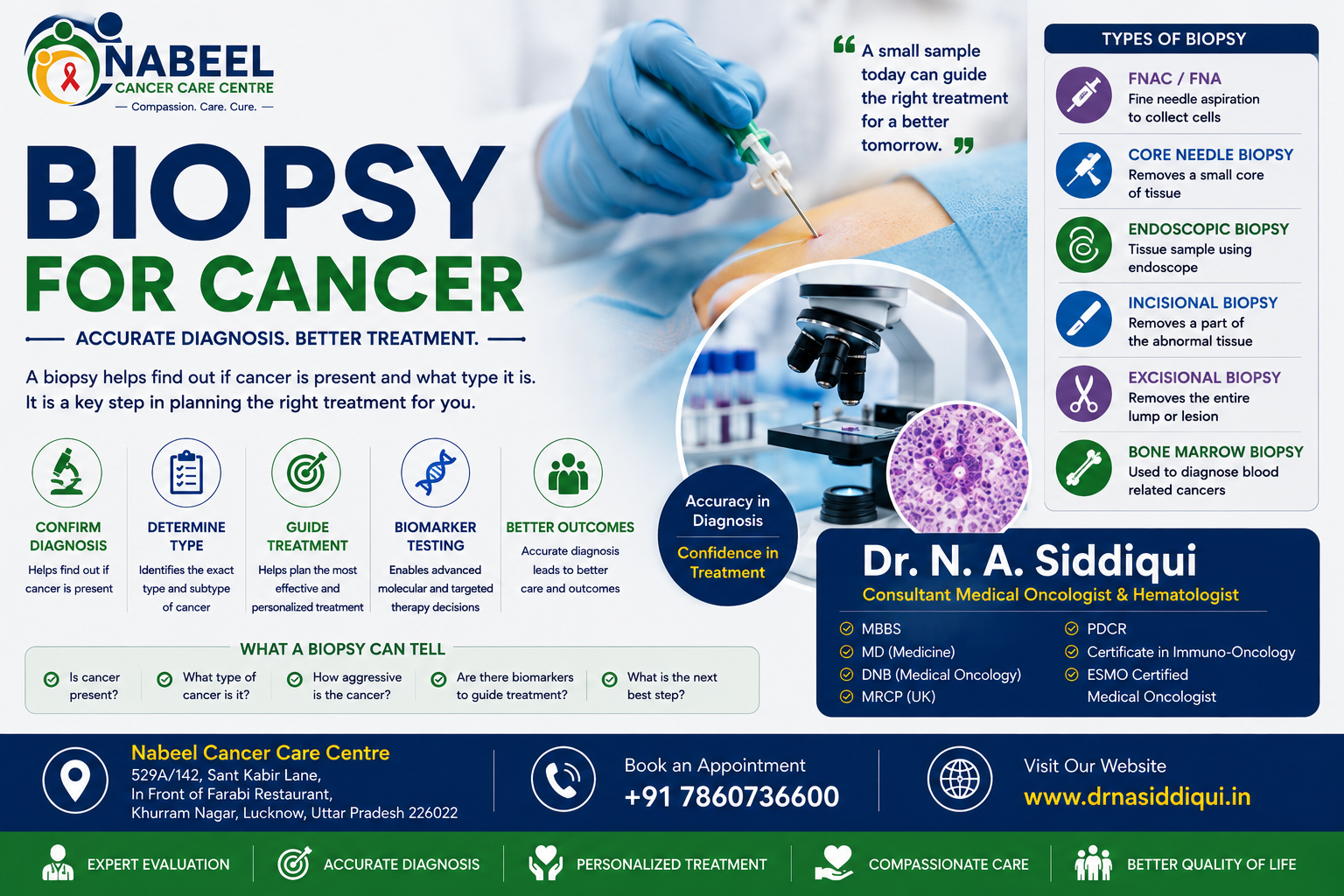
Biopsy for Cancer in Lucknow – Dr. N. A. Siddiqui
When a scan, physical examination or screening test shows a suspicious lump or abnormal area, one of the most common questions patients ask is:
“Is it cancer?”
Imaging such as ultrasound, CT, MRI or PET-CT can provide valuable information about an abnormal area, but imaging alone often cannot confirm exactly what type of cells are present.
For many cancers, a biopsy is the key test used to establish a definite diagnosis.
If you are looking for Biopsy for Cancer in Lucknow, Dr. N. A. Siddiqui, Consultant Medical Oncologist & Hematologist, provides oncology consultation for patients who have a suspicious mass, abnormal scan, newly diagnosed cancer or pathology report requiring further evaluation.
A biopsy does more than simply answer whether a tumor is cancerous. The tissue obtained may help doctors determine the type of cancer, tumor subtype, grade and important molecular or biomarker characteristics that can influence treatment planning.
What Is a Biopsy?
A biopsy is a medical procedure in which a small sample of cells or tissue is removed from the body and examined by a pathologist.
The National Cancer Institute defines biopsy as the removal of cells or tissues for examination by a pathologist, who may study the tissue under a microscope and perform additional laboratory tests.
For many solid tumors, biopsy is one of the most important steps between finding a suspicious abnormality and beginning cancer treatment.
A biopsy may help determine whether an abnormal area represents:
- Cancer
- A benign tumor
- Infection
- Inflammation
- Another non-cancerous condition
This is important because not every suspicious lump or abnormal scan represents cancer.
Why Is a Biopsy Important in Cancer Diagnosis?
Cancer is not one single disease.
Even tumors that arise in the same organ can be biologically different.
For example, different types of lung, breast, stomach or head-and-neck cancer may require substantially different treatment.
A biopsy helps provide tissue that can answer questions such as:
Is cancer present?
What type of cancer is it?
What is the tumor grade?
Where is the cancer likely to have originated?
Are there biomarkers that could affect treatment?
The pathology report created after biopsy can therefore influence treatment choices such as surgery, chemotherapy, immunotherapy, targeted therapy or hormone therapy.
NCI describes the pathology report as a key source for the definitive cancer diagnosis and treatment planning.
When Might a Doctor Recommend a Biopsy?
A biopsy may be recommended when clinical examination or testing identifies something that requires closer evaluation.
Examples include:
- A breast lump
- Suspicious lung nodule
- Enlarged lymph node
- Persistent oral lesion
- Liver mass
- Prostate abnormality
- Thyroid nodule
- Skin lesion
- Abnormal gastrointestinal lesion
- Bone lesion
- Suspicious findings on CT, MRI or PET-CT
Biopsy can also be used in a patient with previously diagnosed cancer when doctors need additional tissue to understand recurrence, progression or molecular characteristics.
The exact decision depends on the suspected disease, location of the lesion and whether obtaining tissue will meaningfully influence management.
Different Types of Biopsy
There is no single biopsy technique for every patient.
Doctors select the procedure according to the location and type of abnormal tissue, the amount of tissue required and patient safety.
Fine Needle Aspiration – FNAC/FNA
Fine Needle Aspiration, often called FNA or FNAC, uses a very thin hollow needle to remove cells or fluid from an abnormal area.
It may be useful for certain:
- Lymph nodes
- Thyroid nodules
- Breast lesions
- Superficial lumps
- Other accessible abnormalities
FNA generally provides individual cells rather than a larger piece of tissue.
This can be sufficient in some clinical situations, but in others a larger tissue sample may be necessary.
Core Needle Biopsy
A core needle biopsy uses a wider hollow needle to remove small cylinders or cores of tissue.
Because the tissue architecture is preserved, a core biopsy can often provide more information than FNA.
It is commonly used for selected lesions involving areas such as:
- Breast
- Liver
- Lung
- Prostate
- Lymph nodes
- Soft tissue
The American Cancer Society distinguishes FNA from core biopsy based on the size of the needle and amount of tissue obtained.
Image-Guided Biopsy
Some abnormalities are deep inside the body and cannot be felt during examination.
Doctors may use imaging to accurately guide the biopsy needle toward the suspicious area.
Guidance can include:
- Ultrasound
- CT
- Mammography
- Other imaging technologies
Image guidance helps the doctor obtain tissue from the correct location while avoiding nearby structures.
Endoscopic Biopsy
Some tissues can be reached using an endoscope—a thin flexible instrument that allows doctors to examine internal organs.
Examples include:
Colonoscopy
A biopsy may be obtained from abnormal tissue in the colon or rectum.
Upper GI Endoscopy
A suspicious area in the esophagus or stomach may be biopsied.
Bronchoscopy
Selected abnormalities in the airways or lungs may be sampled.
NCI lists endoscopic biopsy as an established way of obtaining tissue from internal organs.
Incisional Biopsy
During an incisional biopsy, only part of a larger abnormal area is removed.
This may be appropriate when the entire lesion cannot or should not be removed solely for diagnosis.
Excisional Biopsy
An excisional biopsy removes the entire suspicious lump or abnormal area.
This may be considered for certain small or easily accessible lesions.
NCI defines incisional, excisional and needle biopsy among the common biopsy categories.
Bone Marrow Biopsy
Blood cancers require a different diagnostic approach from many solid tumors.
Bone marrow aspiration and biopsy may be used when doctors suspect or evaluate conditions such as:
- Leukemia
- Multiple myeloma
- Some lymphomas
- Other bone-marrow disorders
Samples can undergo microscopy, flow cytometry, cytogenetics and molecular testing.
Skin Biopsy
A suspicious skin lesion may be evaluated using methods such as:
- Punch biopsy
- Shave biopsy
- Excisional biopsy
The chosen technique depends on the appearance and location of the lesion and the suspected diagnosis.
Biopsy vs FNAC – What Is the Difference?
Patients often use the terms biopsy and FNAC interchangeably.
However, FNAC is one type of biopsy/cytology procedure.
FNAC removes cells using a thin needle.
Core biopsy removes a larger piece of tissue.
The difference can matter because tissue architecture sometimes provides information that individual cells alone cannot provide.
American Cancer Society guidance explains that tissue biopsy shows not only what the cells look like but also how they are arranged within the tissue, while cytology mainly evaluates individual cells.
The doctor decides which test is appropriate based on the suspected cancer and the information required.
What Happens During a Biopsy?
The exact procedure depends on which type of biopsy is being performed.
Before the biopsy, the doctor may review:
- Medical history
- Current medicines
- Blood-thinning medicines
- Allergies
- Previous imaging
- Blood tests
- Bleeding risk
Depending on the procedure, patients may receive:
Local anesthesia to numb a small area.
Sedation to help them relax.
Regional anesthesia for a larger area.
General anesthesia for certain surgical procedures.
NCI notes that biopsy procedures can involve local, regional or general anesthesia depending on the location and method.
After the tissue is obtained, it is carefully labelled and sent to a pathology laboratory.
Does a Biopsy Hurt?
Pain varies according to the procedure and the body area being sampled.
Local anesthesia is often used for needle or superficial biopsies, which can reduce discomfort during the procedure.
Patients may feel:
- Pressure
- A brief needle sensation
- Mild soreness afterward
- Bruising around the site
More invasive procedures may require stronger anesthesia or sedation.
Persistent or increasing pain after a biopsy should be reported to the treating medical team.
Is Biopsy Safe?
Biopsy is a commonly used diagnostic procedure, but like any medical procedure it can have risks.
The possible complications depend on the type and location of the biopsy.
Potential risks can include:
- Bleeding
- Bruising
- Pain
- Infection
- Injury to nearby structures in uncommon situations
- Procedure-specific complications
Needle biopsy usually carries a small risk of bleeding and infection at the needle site.
Doctors assess the expected benefit and procedural risks before recommending biopsy.
Can Biopsy Cause Cancer to Spread?
This is one of the most common fears among patients.
The available medical evidence indicates that tumor seeding after biopsy is extremely rare.
Tumor seeding means cancer cells theoretically become deposited along the path of a biopsy needle.
The American Cancer Society notes that although this can technically happen, it is extremely uncommon and the benefit of obtaining an accurate cancer diagnosis generally far outweighs this minimal risk.
Certain uncommon cancers or anatomical situations may require a particular biopsy technique or surgical strategy to reduce risk.
This is why the biopsy route should be planned by clinicians familiar with the suspected cancer rather than avoided because of fear that every biopsy spreads cancer.
What Happens to the Tissue After Biopsy?
After biopsy, the tissue is sent to a pathologist.
A pathologist is a doctor specially trained in diagnosing disease by studying cells and tissues.
The laboratory may process, stain and examine tissue under a microscope.
Depending on the cancer, additional tests may include:
- Immunohistochemistry
- Special stains
- Flow cytometry
- Cytogenetics
- Molecular tests
- Biomarker testing
- Next-generation sequencing
The amount and type of testing depends on the suspected diagnosis.
What Is a Pathology Report?
A pathology report summarizes the findings from the tissue examination.
Depending on the case, it may include:
- Tissue source
- How the sample was obtained
- Microscopic description
- Final diagnosis
- Cancer type
- Tumor grade
- Surgical margins where relevant
- Lymph-node findings
- Biomarker results
- Additional comments
NCI explains that the final diagnosis section identifies the cancer type and may include clinically important details such as grade, lymph-node and margin status.
Patients should review their pathology report with the treating oncologist rather than interpreting individual terms without clinical context.
Immunohistochemistry – IHC After Biopsy
Immunohistochemistry, often shortened to IHC, uses antibodies to identify particular proteins in tumor cells.
It can help:
- Confirm the cancer type
- Identify tumor origin
- Distinguish similar tumors
- Determine cancer subtype
- Identify certain treatment-related biomarkers
Examples include hormone receptors and HER2 testing in breast cancer and other disease-specific markers.
The appropriate IHC panel depends on the suspected diagnosis.
Biomarker Testing and Molecular Testing
A biopsy can sometimes provide tissue not only for diagnosis but also for precision oncology testing.
Biomarker testing examines genes, proteins or other characteristics of the tumor.
In selected cancers, these findings can help determine whether a patient might benefit from:
- Targeted therapy
- Immunotherapy
- Hormone therapy
- Other personalized treatments
For patients with advanced disease, obtaining enough high-quality biopsy tissue for molecular testing can sometimes be important.
What If the Biopsy Is Negative but the Scan Still Looks Suspicious?
A negative biopsy is reassuring in many cases, but the result must always be interpreted together with clinical and imaging findings.
Occasionally:
- The lesion is genuinely benign
- The biopsy sample may be too small
- The needle may not have sampled the most abnormal area
- Additional pathology testing may be required
If imaging, symptoms and pathology do not match, doctors may recommend:
- Pathology review
- Repeat imaging
- Repeat biopsy
- Different biopsy method
- Clinical follow-up
The correct next step depends on the specific situation.
Can Biopsy Determine the Stage of Cancer?
A biopsy primarily helps determine what the tumor is.
Staging generally requires additional information.
Depending on the cancer, this can include:
- CT
- MRI
- PET-CT
- Lymph-node assessment
- Surgical findings
- Pathology results
- Other tests
However, biopsy information can contribute to staging.
For example, finding cancer cells in a lymph node or distant lesion can affect the stage.
Sentinel Lymph Node Biopsy
For selected cancers, particularly breast cancer and melanoma, doctors may perform a sentinel lymph node biopsy.
The sentinel lymph node is among the first lymph nodes where cancer would be expected to spread from the primary tumor.
Examining it may help determine whether cancer has reached nearby lymph nodes and influence staging and treatment decisions.
How Long Do Biopsy Results Take?
There is no universal timeline.
Some straightforward pathology results may be available relatively quickly, while complex cases can take longer because additional testing may be required.
The pathologist may need:
- Special stains
- Immunohistochemistry
- Molecular testing
- Expert review
Patients should avoid assuming that a longer processing time necessarily means a more serious diagnosis.
Ask the treating centre when the report is expected and schedule an appointment to discuss the findings.
What Should You Ask After Receiving a Biopsy Report?
Important questions may include:
- Is cancer confirmed?
- What exact cancer type is present?
- What is the tumor subtype or grade?
- Do I need additional pathology tests?
- Do I need biomarker or molecular testing?
- What scans are required for staging?
- Should my pathology be reviewed again?
- What treatment options are available?
- How soon should treatment begin?
A biopsy is usually the beginning of the treatment-planning process rather than the final step.
When Is a Second Pathology Opinion Helpful?
A second pathology review may be useful when:
- Cancer is rare
- Diagnosis is unclear
- Pathology reports disagree
- Tumor subtype will significantly change treatment
- A major treatment decision depends on pathology
- Tissue quality is limited
Patients may need to provide the original slides or tissue blocks for specialist review.
About Dr. N. A. Siddiqui – Medical Oncologist in Lucknow
Dr. N. A. Siddiqui is a Consultant Medical Oncologist & Hematologist practicing in Lucknow.
Qualifications
- MBBS
- MD (Medicine)
- DNB (Medical Oncology)
- MRCP (UK)
- PDCR
- Certificate in Immuno-Oncology
- ESMO Certified Medical Oncologist
Patients may consult Dr. Siddiqui after a biopsy or abnormal cancer investigation for:
- Pathology review
- Cancer diagnosis interpretation
- Cancer staging
- Biomarker-test planning
- Molecular testing review
- Treatment planning
- Chemotherapy
- Immunotherapy
- Targeted therapy
- Cancer second opinion
Cancer treatment should ideally begin only after the oncology team clearly understands the diagnosis, disease stage and relevant biological characteristics.
What Should You Bring to an Oncology Appointment After Biopsy?
Bring all available records, particularly:
- Biopsy report
- Histopathology report
- IHC report
- Pathology slides or blocks if requested
- Ultrasound report
- CT or MRI reports
- PET-CT reports
- Imaging CDs
- Blood tests
- Previous medical records
- Molecular or NGS reports if already performed
Having complete records can help reduce unnecessary duplication of tests.
Frequently Asked Questions About Cancer Biopsy
Is biopsy the only test for cancer?
No. Cancer diagnosis may involve examination, blood tests, imaging and other procedures. However, for many cancers, biopsy is the most definitive way to confirm the diagnosis.
What is the difference between FNAC and core biopsy?
FNAC uses a thinner needle to collect cells, whereas a core biopsy removes a larger tissue sample that preserves tissue architecture. The best procedure depends on the suspected condition.
Can biopsy make cancer spread?
Cancer spread from biopsy is considered extremely rare. Modern biopsy techniques are designed to minimize this risk, and the diagnostic benefit usually greatly outweighs it.
Does a positive biopsy always mean chemotherapy?
No. Treatment depends on the cancer type, stage and biology. Some patients require surgery, some radiation, some systemic therapy and others a combination.
Can a biopsy tell which cancer medicine will work?
Sometimes the biopsy tissue can undergo biomarker or molecular testing that helps guide targeted therapy, immunotherapy or other treatment. It does not guarantee response.
Is biopsy required before chemotherapy?
For most solid tumors, doctors generally seek pathological confirmation before starting systemic cancer treatment when obtaining tissue is clinically feasible. There are specific exceptions depending on the disease and circumstances.
Do I need another biopsy if cancer returns?
Not always. A repeat biopsy may sometimes be useful when the diagnosis is uncertain, biology may have changed or additional molecular testing could influence treatment.
Consult Dr. N. A. Siddiqui After a Cancer Biopsy in Lucknow
If you have been advised a biopsy, received a biopsy report or need help understanding a confirmed cancer diagnosis, you can consult Dr. N. A. Siddiqui for oncology evaluation in Lucknow.
The objective is to interpret the biopsy together with imaging, staging investigations and relevant biomarkers so that treatment decisions are based on the complete clinical picture.
Dr. N. A. Siddiqui
Consultant Medical Oncologist & Hematologist
MBBS, MD (Medicine)
DNB (Medical Oncology)
MRCP (UK), PDCR
Certificate in Immuno-Oncology
ESMO Certified Medical Oncologist
Nabeel Cancer Care Centre
529A/142, Sant Kabir Lane, In Front of Farabi Restaurant,
Khurram Nagar, Lucknow
Appointment: +91 7860736600
Website: www.drnasiddiqui.in
BOOK A CANCER DIAGNOSIS CONSULTATION
Medical Disclaimer
This article is intended for general educational purposes only. The need for biopsy, biopsy technique, risks, anesthesia, pathology testing and treatment decisions differ between patients. Always follow the recommendations of the doctor or medical team managing your individual case.