
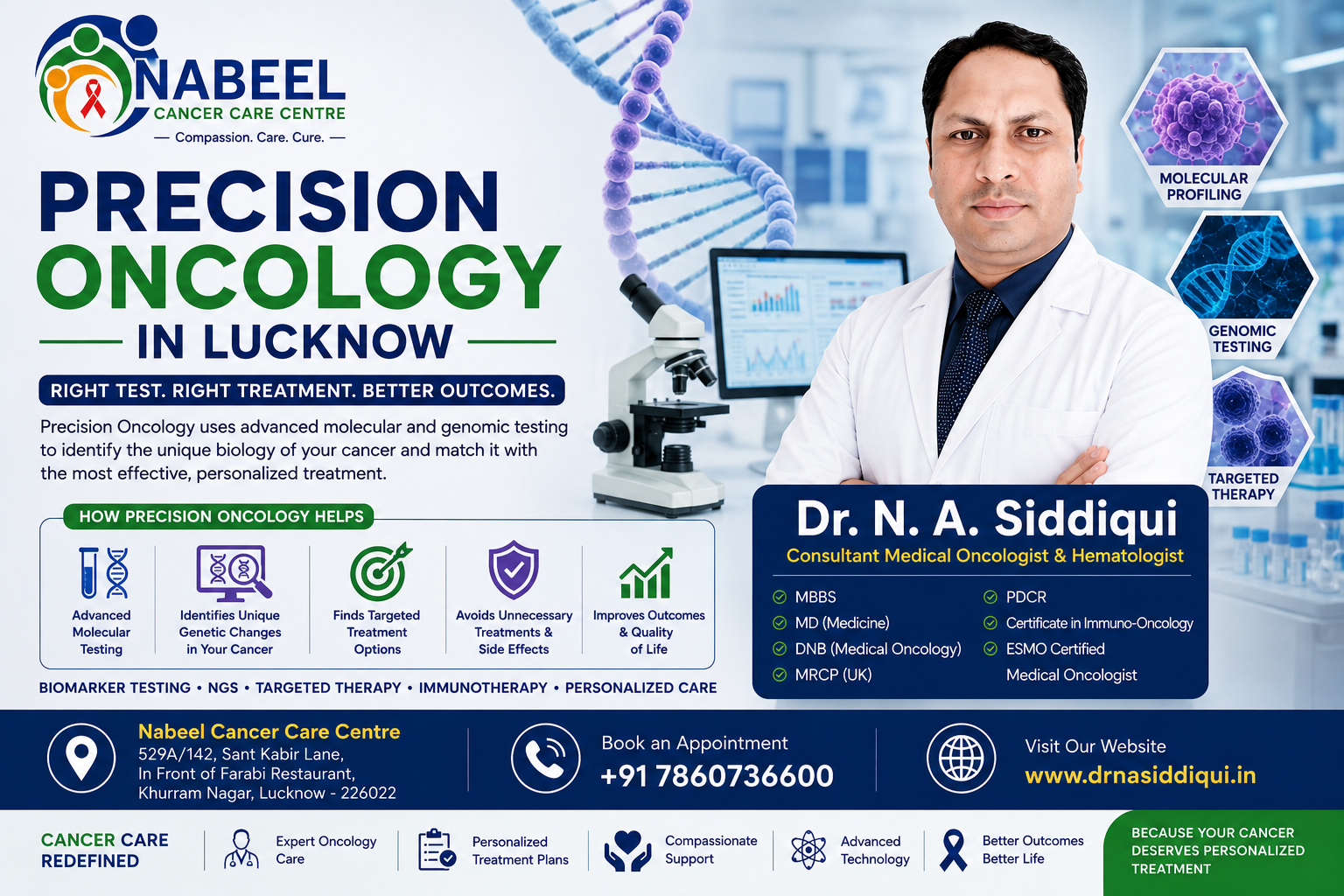
Precision Oncology in Lucknow – Personalized Cancer Treatment with Dr. N. A. Siddiqui
Cancer treatment is becoming increasingly precise.
Traditionally, treatment decisions were largely based on where cancer started, how it looked under the microscope and how far it had spread. These factors remain extremely important, but modern oncology can sometimes go further by examining the biological and molecular features of an individual tumor.
This approach is known as precision oncology.
If you are looking for Precision Oncology in Lucknow, Dr. N. A. Siddiqui, Consultant Medical Oncologist & Hematologist, provides individualized cancer treatment planning that may incorporate pathology, biomarker testing, molecular profiling, targeted therapy, immunotherapy and other evidence-based treatments when clinically appropriate.
Precision oncology does not mean that every patient requires extensive genetic testing or that every molecular test will identify a special medicine. Instead, it means using the most relevant information about a patient's cancer to make treatment decisions as accurately as possible.
The National Cancer Institute describes precision medicine in cancer as an approach that uses biomarker and other testing to help select treatments more likely to benefit an individual patient while potentially avoiding treatments that are unlikely to help.
What Is Precision Oncology?
Precision oncology is an approach to cancer care in which doctors use specific characteristics of a patient's tumor to help guide treatment.
These characteristics may include:
- Cancer type and subtype
- Stage of cancer
- Histopathology
- Protein expression
- Hormone-receptor status
- Gene mutations
- Gene fusions or rearrangements
- Microsatellite instability
- Mismatch-repair status
- Other molecular or immune biomarkers
Two patients can have cancer arising from the same organ but have significantly different molecular characteristics.
For example, two people may both have lung cancer, yet one tumor may contain a molecular alteration for which an effective targeted therapy exists, while the other may not.
Similarly, some breast cancers are driven by hormone receptors, some by HER2, and others may have different biological features that affect treatment selection.
Precision oncology therefore asks not only:
“Where did the cancer start?”
but also:
“What biological changes are driving this particular cancer, and are any of them clinically useful for treatment selection?”
Precision Oncology Is More Than Targeted Therapy
Precision oncology and targeted therapy are closely related, but they are not identical.
Precision oncology refers to the broader strategy of using biological and molecular information to guide cancer care.
Targeted therapy refers to medicines designed to interfere with specific molecular targets or pathways involved in cancer growth.
Biomarker testing can also help determine eligibility for certain immunotherapies, hormone therapies or other treatments.
The National Cancer Institute notes that some targeted therapies and immunotherapies work only in patients whose cancers contain particular biomarkers.
What Is Biomarker Testing?
Biomarkers are genes, proteins or other measurable characteristics that provide information about cancer.
Biomarker testing may also be called:
- Tumor profiling
- Molecular testing
- Molecular profiling
- Tumor genetic testing
- Somatic testing
- Genomic testing
- Genomic profiling
Some biomarker tests examine one specific marker.
Others examine many genes or molecular alterations at the same time.
The test selected should depend on the cancer type and the clinical question being asked.
Testing should not be performed simply because a large test panel exists.
Why Biomarker Testing Is Important
A clinically useful biomarker may help an oncologist determine:
- Whether a particular targeted treatment may work
- Whether a treatment is unlikely to work
- Whether immunotherapy may be appropriate
- Whether additional testing is required
- Whether a clinical trial may be relevant
- Whether treatment should change after disease progression
The FDA describes companion diagnostics as tests that can help identify patients who are most likely to benefit from a specific treatment or who may have increased risk from that treatment.
What Is Next-Generation Sequencing (NGS)?
Next-Generation Sequencing, commonly called NGS, is a laboratory technology that can analyze many genes or genomic regions at the same time.
Instead of checking only one mutation individually, an NGS panel may examine multiple genes for alterations that could influence cancer treatment.
Depending on the test, NGS may detect:
- Gene mutations
- Insertions or deletions
- Gene amplifications
- Gene fusions
- Other genomic changes
- Selected genomic signatures
Modern comprehensive genomic profiling assays can examine hundreds of genes, but a larger test is not automatically more useful.
The important question is whether the information produced has proven clinical relevance for the patient's cancer.
Current ESMO guidance recommends tumor NGS in several advanced cancers where molecular findings can guide treatment, including advanced non-squamous non-small-cell lung cancer, prostate cancer, colorectal cancer, cholangiocarcinoma, ovarian cancer and, in updated recommendations, selected advanced breast cancers and certain rare cancers.
Which Patients May Benefit From Precision Oncology?
Precision oncology may be especially relevant when treatment decisions depend on tumor biology.
Examples include patients with:
- Advanced or metastatic cancer
- Cancer that has returned after previous treatment
- Cancers with established molecular targets
- Rare cancers where molecular classification may be helpful
- Cancer of unknown primary in selected situations
- Disease that has progressed despite standard treatment
- Situations where several treatment options exist and biomarker results may help guide selection
ASCO recommends genomic sequencing for patients with metastatic or advanced solid tumors when approved treatments are linked to specific genomic biomarkers, and multigene panels are particularly useful when multiple biomarker-linked treatments exist for the disease.
Not every early-stage cancer patient requires broad genomic sequencing.
The decision should be based on clinical evidence rather than automatically ordering NGS for every cancer diagnosis.
Precision Oncology in Lung Cancer
Lung cancer is one of the clearest examples of how molecular testing has changed modern cancer treatment.
In selected non-small-cell lung cancers, clinically relevant molecular alterations may involve genes such as:
EGFR, ALK, ROS1, BRAF, KRAS, MET, RET and NTRK.
PD-L1 testing may also help guide immunotherapy decisions.
The exact testing panel depends on histology, cancer stage and current treatment guidelines.
For patients whose cancer has an actionable molecular alteration, targeted therapy may sometimes become an important component of treatment.
Precision Oncology in Breast Cancer
Breast cancer treatment has long incorporated biological tumor characteristics.
Important biomarkers may include:
- Estrogen receptor (ER)
- Progesterone receptor (PR)
- HER2
In selected clinical situations, additional testing may examine genes or molecular alterations such as BRCA1/2, PIK3CA, ESR1 and other markers that can influence treatment.
This demonstrates an important principle of precision oncology:
Cancer should not always be treated solely according to the organ in which it began. The biological subtype can significantly affect which treatment is appropriate.
Precision Oncology in Colorectal Cancer
Molecular testing may also influence treatment decisions in advanced colorectal cancer.
Depending on the clinical situation, testing can include biomarkers such as:
- RAS alterations
- BRAF
- MSI/MMR status
- HER2 in selected tumors
- Other molecular changes
Some biomarkers may indicate that particular targeted therapies are unlikely to work, while others may identify treatment options.
This is another reason biomarker reports should be interpreted by an oncologist rather than treated as simple “positive” or “negative” genetic results.
Precision Oncology in Ovarian and Other Cancers
Selected ovarian cancers may require molecular evaluation, including assessment related to BRCA or homologous recombination pathways.
Molecular testing also has established or emerging roles in selected:
- Prostate cancers
- Cholangiocarcinomas
- Thyroid cancers
- Sarcomas
- Gastrointestinal stromal tumors
- Cancers of unknown primary
- Other advanced malignancies
ESMO's updated precision medicine recommendations expanded NGS guidance to additional advanced and rare cancers because the number of clinically actionable genomic findings has increased.
Tumor-Agnostic Cancer Treatment
One of the most important developments in precision oncology is tumor-agnostic treatment.
Traditionally, anti-cancer medicines were developed for cancers based primarily on the organ of origin.
Tumor-agnostic treatments instead target particular molecular features that may occur across different cancer types.
Examples of molecular features relevant to tumor-agnostic treatment strategies can include selected:
- NTRK gene fusions
- MSI-high or mismatch-repair deficiency
- High tumor mutational burden in certain contexts
- Other validated genomic alterations
However, molecular results must be matched with appropriate clinical evidence and locally available approved treatments.
ESMO recommends NGS to identify tumor-agnostic molecular alterations in metastatic cancers where matched treatments are accessible.
Tissue Biopsy vs Liquid Biopsy
Most molecular profiling is performed using tumor tissue obtained from biopsy or surgery.
However, some patients may undergo a liquid biopsy.
Liquid biopsy typically examines tumor-derived DNA circulating in the bloodstream.
Potential advantages include:
- Blood-based collection
- Avoiding an invasive tissue biopsy in some situations
- Molecular analysis when tissue is difficult to obtain
- Potential assessment of evolving cancer biology
However, liquid biopsy has limitations.
A negative blood-based result does not necessarily prove that the tumor has no actionable genomic alteration because insufficient tumor DNA may be present in the bloodstream.
FDA information for approved liquid genomic profiling assays specifically notes that negative plasma results may sometimes require confirmation using tumor tissue where feasible.
Tumor Genetic Testing vs Hereditary Genetic Testing
Patients frequently confuse these two forms of genetic testing.
They answer different questions.
Tumor or Somatic Testing
This looks for genetic changes present in cancer cells.
These changes commonly develop during a person's lifetime and are used primarily to understand the tumor and potentially guide treatment.
Germline or Hereditary Genetic Testing
This looks for inherited gene changes that may have been present from birth.
Testing usually uses blood, saliva or another normal tissue sample and may identify inherited cancer-risk syndromes.
NCI emphasizes that tumor genetic testing does not replace testing for inherited cancer risk.
Sometimes tumor testing identifies a change that raises the possibility of an inherited mutation. In that situation, confirmatory germline testing and genetic counselling may be appropriate.
How Precision Oncology Treatment Planning Works
A precision oncology approach may involve several steps.
First, the oncologist reviews:
- Biopsy and histopathology
- Cancer stage
- Imaging
- Previous treatment
- Patient health and performance status
Next, appropriate tumor biomarkers are identified according to the cancer type.
Testing may involve:
- Immunohistochemistry
- PCR
- FISH
- Single-gene testing
- Multigene NGS
- Liquid biopsy
- Other specialized assays
The laboratory report is then interpreted in context.
A molecular result may be categorized as:
- Clinically actionable
- Potentially actionable
- Investigational
- Currently not actionable
- A variant of uncertain significance
A genomic alteration should not be treated simply because it appears on a laboratory report.
Clinical evidence must show that targeting that alteration is meaningful for that specific disease or situation.
ESMO's ESCAT framework was developed specifically to rank the level of clinical evidence supporting genomic alteration–drug matches.
Precision Oncology Does Not Guarantee a Targeted Drug
One of the most important points for patients to understand is that molecular testing does not always lead to a targeted treatment.
Testing may show:
- No clinically relevant alteration
- An alteration without an available medicine
- A variant whose significance is uncertain
- A potential target supported only by early research
- A therapy that is unavailable locally
- A treatment that may be less effective than standard therapy
NCI notes that biomarker testing does not help every patient and that even when a matching biomarker and treatment are found, the treatment may still not work because of biological differences, tumor heterogeneity or other factors.
This is why precision oncology should remain evidence-based, not simply test-driven.
Can Cancer Biomarkers Change Over Time?
Yes.
Cancer evolves.
Molecular characteristics can sometimes change as the tumor grows or develops resistance to treatment.
This means an older biopsy may not always represent the current molecular state of a recurrent or progressive cancer.
NCI notes that biomarker testing provides a snapshot at one point in time and that repeat testing may sometimes be considered when cancer returns or progresses.
Whether another biopsy or liquid biopsy is needed should be determined by the treating oncologist.
Precision Oncology and Targeted Therapy
Targeted therapy is one of the major practical applications of precision oncology.
Targeted medicines may block:
- Cancer-driving proteins
- Abnormal enzymes
- Growth-signaling pathways
- Specific molecular abnormalities
NCI explains that most patients require testing to determine whether their tumors contain a molecular target for which an appropriate targeted treatment exists.
Internal Link: Targeted Therapy Doctor in Lucknow
Precision Oncology and Immunotherapy
Biomarkers can also influence immunotherapy decisions.
Depending on the cancer, testing may evaluate factors such as:
- PD-L1
- MSI/MMR
- Tumor mutational burden
- Other immune-related biomarkers
However, immunotherapy should not be prescribed simply because one biomarker is present.
The cancer type, treatment line, overall clinical condition and regulatory or guideline context remain important.
Precision Oncology for Advanced and Stage 4 Cancer
Precision oncology is particularly relevant in many advanced or metastatic cancers because multiple treatment lines may be available and molecular profiling can sometimes identify additional therapeutic options.
Patients with advanced disease may benefit from review of:
- Existing pathology
- Previous biomarker results
- Previous chemotherapy
- Previous targeted therapy
- Previous immunotherapy
- Molecular resistance mechanisms
- Potential need for repeat testing
About Dr. N. A. Siddiqui – Precision Oncology in Lucknow
Dr. N. A. Siddiqui is a Consultant Medical Oncologist & Hematologist practicing in Lucknow.
Qualifications
- MBBS
- MD (Medicine)
- DNB (Medical Oncology)
- MRCP (UK)
- PDCR
- Certificate in Immuno-Oncology
- ESMO Certified Medical Oncologist
His cancer-care approach includes personalized treatment planning with chemotherapy, immunotherapy, targeted therapy, hormone therapy and precision oncology when clinically appropriate.
Dr. Siddiqui's official website also lists precision oncology among the advanced cancer-care services provided at Nabeel Cancer Care Centre.
What to Bring for a Precision Oncology Consultation
Patients who already have a cancer diagnosis should bring available:
- Biopsy report
- Histopathology
- Immunohistochemistry
- Pathology blocks or slides if advised
- CT, MRI or PET-CT reports
- Existing molecular-testing reports
- NGS reports
- Genetic-test reports
- Previous chemotherapy records
- Targeted-therapy history
- Immunotherapy history
- Surgery and radiation summaries
- Recent blood investigations
The objective is to avoid unnecessary repeat testing and determine which additional information may genuinely influence treatment.
Frequently Asked Questions
What is precision oncology?
Precision oncology uses characteristics of an individual cancer—including biomarkers and molecular features—to help guide diagnosis and treatment decisions.
Is precision oncology the same as targeted therapy?
No. Targeted therapy is one type of treatment that may result from precision oncology. Precision oncology is the broader process of testing, interpreting and using tumor biology to individualize cancer care.
Does every cancer patient need NGS testing?
No. NGS is most useful when genomic information is likely to change treatment. The indication depends on cancer type, stage and available treatment options.
Can NGS tell which medicine will definitely cure cancer?
No. Genomic testing may identify treatment options, but it cannot guarantee that a medicine will work or cure the cancer.
What is an actionable mutation?
An actionable molecular alteration is one for which sufficient evidence suggests that the finding can influence a clinical decision, such as selecting or avoiding a particular treatment.
Can precision oncology be used for Stage 4 cancer?
Yes. Molecular testing can be especially relevant in many advanced or metastatic cancers when biomarker-directed treatments are available.
Is liquid biopsy better than tissue biopsy?
Neither is universally better. Tissue and blood-based testing have different strengths and limitations. The appropriate method depends on the clinical situation.
Is tumor genetic testing inherited?
Usually not. Most tumor genetic alterations are somatic and developed during life. Hereditary or germline testing is different.
Consult Dr. N. A. Siddiqui for Precision Oncology in Lucknow
Modern cancer care is increasingly moving away from a purely one-size-fits-all model.
For selected patients, understanding the molecular biology of a tumor can help identify more appropriate treatments, avoid ineffective therapies and guide the use of targeted therapy or immunotherapy.
If you are seeking Precision Oncology in Lucknow, Dr. N. A. Siddiqui provides medical oncology consultation and individualized cancer treatment planning based on pathology, stage, biomarker findings and overall clinical condition.
Dr. N. A. Siddiqui
Consultant Medical Oncologist & Hematologist
MBBS, MD (Medicine)
DNB (Medical Oncology)
MRCP (UK), PDCR
Certificate in Immuno-Oncology
ESMO Certified Medical Oncologist
Nabeel Cancer Care Centre
529A/142, Sant Kabir Lane, In Front of Farabi Restaurant,
Khurram Nagar, Lucknow
Appointment: +91 7860736600
Website: www.drnasiddiqui.in
BOOK A PRECISION ONCOLOGY CONSULTATION
Medical Disclaimer
This article is intended for general educational purposes only and does not replace an individual oncology consultation or treatment recommendation. Biomarker and genomic testing should be selected and interpreted according to cancer type, stage, clinical evidence, treatment availability and the patient's overall condition.